

Understanding disc changes and alternative care options
Being told you have degenerative disc disease can sound alarming. The term suggests that something is deteriorating or progressively worsening, which can understandably cause concern.
At the Devon Disc Centre, we help people understand what degenerative disc disease actually means, why it occurs, and what conservative options may be appropriate before considering invasive intervention.
Degenerative disc symptoms are often influenced by lifestyle factors such as:prolonged sitting, repetitive movement, occupational loading, stress, and reduced recovery often contribute over time. Addressing these influences will support longer-term improvement.
Degenerative Disc Disease
What is Degenerative Disc Disease
Degenerative disc disease is a term used to describe age-related or load-related changes within the spinal discs. Spinal discs act as cushions between the vertebrae. Over time, discs may gradually:
-
Lose hydration
-
Become less flexible
-
Reduce in height
-
Develop small bulges or irregularities
These changes are common and often occur naturally as part of the ageing process. Many people with degenerative disc changes experience little or no pain. Despite the name, degenerative disc disease is not always a progressive or disabling condition.

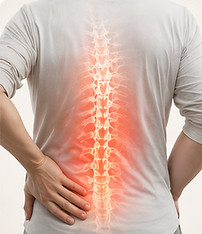
Common symptoms of degenerative disc disease
Some people experience no symptoms at all. Others may experience:
-
Back or neck pain
-
Stiffness
-
Pain that worsens with sitting
-
Fluctuating discomfort
-
Reduced tolerance to movement
-
Occasional nerve related symptoms
Symptoms often vary and may change over time.
Why we Experience
Degenerative Disc Changes
Disc changes typically develop gradually over time as we naturally age. The rate and severity of degeneration is often driven by a combination of age-related factors, prolonged sitting, and repetitive loading, as well as previous injuries, occupational demands, and levels of stress we experience. These factors influence how discs adapt to load rather than representing a single injury.
Why degenerative disc disease causes pain
Pain is not always caused by the disc itself. Symptoms often arise from:
-
Reduced movement between spinal segments
-
Increased load on surrounding joints
-
Protective muscle guarding
-
Nervous system sensitivity
-
Reduced adaptability to movement and posture
This is why imaging findings do not always match symptom severity.
Where Degenerative Disc Disease Occurs
Degenerative disc changes can occur in different regions.
Lumbar degenerative disc disease
Changes in the lower back may contribute to:
-
Lower back pain
-
Stiffness
-
Pain with sitting or bending
-
Occasional leg symptoms
Cervical degenerative disc disease
Changes in the neck may contribute to:
-
Neck pain or stiffness
-
Headaches
-
Shoulder or arm discomfort
-
Reduced neck mobility
A thorough suitability assessment allows us to identify the source of your symptoms, determine whether spinal compression is a contributing factor, assess the neurological involvement, identify any red flags or contraindications, and decide whether decompression is an appropriate care option.

Is Degenerative Disc Disease Progressive
Although the term suggests progression, many people experience stable or fluctuating symptoms rather than steady decline. Some people improve significantly with alternative care and are able to maintain a good level of health. Disc changes often represent adaptation rather than deterioration.
Can degenerative disc disease improve?
While structural changes may remain, symptoms often improve when:
-
Compression is reduced
-
Movement improves
-
Nervous system responses settle
-
Load is managed appropriately
Our care focuses on improving function and tolerance rather than reversing structural changes.

Non-surgical spinal decompression is designed to gently reduce pressure within the spine and support disc recovery.
In appropriate cases, decompression may:
-
Reduce pressure on the disc
-
Improve disc hydration and healing
-
Create space around irritated nerve tissue
-
Improve comfort during movement and sitting
-
Support a calmer neurological response
At the Devon Disc Centre, decompression is delivered using biofeedback monitored technology, allowing care to be instantly adjusted in real-time based on how the body responds during each session.
How Spinal Decompression Can Help
Living with Degenerative Disc Disease
For many people, degenerative disc disease is best understood as a condition that can be managed rather than feared. Ongoing care may help:
-
Maintain movement and adaptability
-
Reduce flare-ups
-
Improve confidence and function
-
Support long-term spinal health
This approach focuses on resilience rather than restriction.
Before starting treatment, a thorough assessment is essential to ensure safety and suitability by determining if disc changes are contributing to symptoms, identifying nerve involvement, and deciding whether decompression or an alternative care plan is most appropriate.
Frequently Asked Questions

Taking the next step
If you have been diagnosed with degenerative disc disease or suspect disc changes may be contributing to your symptoms, assessment is the appropriate place to begin.
This allows us to determine whether non-surgical spinal decompression or other alternative approaches may be suitable.
Book an assessment with the Devon Disc Centre to explore the most appropriate way forward.